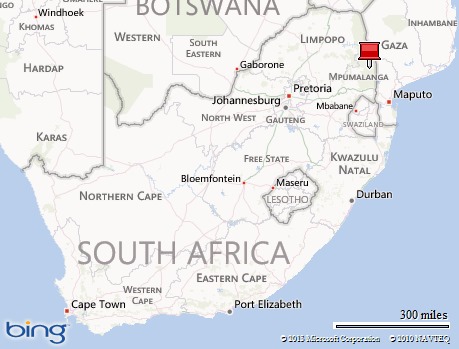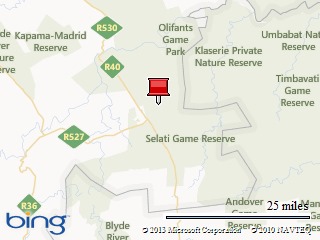
From the Kruger Park we headed back to Hoedspruit, where we met Hennie, a guide/ranger my parents originally met at the Kruger Park about ten years ago, and with whom they have subsequently spent many times camping out, walking and visiting the bush. Andres and I have heard lots about him, and we’re eagerly anticipating our time with him at Nyala camp where he used to have a permanent concession. The camp lies about 25 km northeast of Hoedspruit, part of a large conservancy that is bordered on the east by Kruger Park. Recently there has been movement to incorporate more wildlife areas into the “greater Kruger” by doing away with fences, but Hennie maintains this doesn’t always have the best results. Presently there is an overpopulation of elephants in Nyala, and they are on the road to systematically destroying the habitat for themselves, without any manageable solution.
Nyala is small, has about 6 rondavels and a main house, enclosed, as always by electrified fence. It perches high above the presently dry Olifants River. Last year the region was devastated by the tail end of a hurricane that blew in from the Indian Ocean, leaving the river double in size, as torrential rains brought water levels up into camp, wiping out bridges in the region and leaving the camp isolated for over a month. By coincidence my parents managed to escape from the camp just prior to the onslaught of the raging waters—due in no small part to Hennie’s foresight. They are astounded by the devastation wreaked on the riverbed, which although bone dry at the moment, is more than double its original width and strewn with skeletal trees, mounded up like toothpicks near newly carved river banks. Entirely new rock foundations have been unearthed as well.
We settle in to our lovely rooms, and meet Lizzy—general housekeeper and cook—and Gideon, resident ranger, guide, driver and handyman. Our days fall into a steady routine. We leave for a morning drive at 6am after a nominal early morning bite, return by 9:30ish, indulge in a hefty cooked breakfast, and then relax til about 3ish, when Gideon reappears for the second daily drive. We return to camp by 6ish, as night falls. Lizzy will have lit the fire, and while we enjoy the mesmerizing flames and heat, dinner begins to appear. Some of the food is prepared by Lizzy in the kitchen, while Hennie does the honors at the grill. We manage to scarf down biblical amounts of sustenance, then enjoy another stint at the fire and slowly wander off to bed.
During the daytime hours at camp we keep watch over the nearby waterhole, which is visited by monkeys, baboons, elephants and buck during our stay. In the evening we hear an occasional lion roaring, and several times a hyena’s territorial call. On the drives we see elephants—some of whom are a mite too threatening for my taste—, and lots of rhino. The big cats all elude us. We make several short jaunts into the bush on foot—one to see a huge bull rhino up close and personal--. Hennie stops often to explain about different plants—one that is used to make rope, another that can be used as a toothbrush, different ones that have medicinal purposes, plants with two types of thorns that grow in a spiral to better protect its leaves, a grass that smells like turpentine. There are bushes that giraffes stand over to rub their groins to remove ticks. Endlessly fascinating, but sadly more information that I can absorb or remember. Termite hills are a lesson in heating/cooling architecture, and we see little traps in the sand for capturing ants. Hennie differentiates the tracks of different animals, and even shows us how the scat of various animals shows how differently they digest similar material. He can imitate many of the animals and knows what sounds to use to attract them. He points out birds, often recognizing them as they zip by in a blur. We even have a nasty flat tire courtesy of some errant and razor-sharp tree root. A lifetime of being in and around the bush, a continued fascination for its many facets and the intimate connectedness of all the life there is something Hennie shares with ease and evident passion. He’s a joy to be with in the bush, and he and Gideon are a masterful duo of trackers and raconteurs.
Again, the pictures speak for themselves. Many thanks to Hennie and Gideon for their patience and perseverance—and their tolerance for my constant questions.